A computer network or data network is a telecommunications network which allows computers to exchange data. In computer networks, networked computing devices pass data to each other along data connections (network links). Data is transferred in the form of packets. The connections between nodes are established using either cable media or wireless media. The best-known computer network is the Internet.
Network computer devices that originate, route and terminate the data are called network nodes. Nodes can include hosts such as personal computers, phones, servers as well as networking hardware. Two such devices are said to be networked together when one device is able to exchange information with the other device, whether or not they have a direct connection to each other.
Computer networks differ in the transmission media used to carry their signals, the communications protocols to organize network traffic, the network's size, topology and organizational intent. In most cases, communications protocols are layered on (i.e. work using) other more specific or more general communications protocols, except for the physical layer that directly deals with the transmission media.Computer networks support applications such as access to the World Wide Web, shared use of application and storage servers, printers, and fax machines, and use of email and instant messaging applications.
History
A computer network, or simply a network, is a collection of computers and other hardware components interconnected by communication channels that allow sharing of resources and information. As of 2015 computer networks are the core of modern communication. Computers control all modern aspects of the public switched telephone network (PSTN). Telephony increasingly runs over the Internet Protocol, although not necessarily over the public Internet. The scope of communication has increased significantly in the past decade. This boom in communications would not have been possible without the progressively advancing computer network. Computer networks, and the technologies that make communication between networked computers possible, continue to drive computer the hardware, software, and peripherals industries. The expansion of related industries is mirrored by growth in the numbers and types of people using networks, from the researcher to the home user.
The chronology of significant computer-network developments includes:
- In the late 1950s early networks of communicating computers included the military radar system Semi-Automatic Ground Environment (SAGE).
- In 1959 Anatolii Ivanovich Kitov proposed to the Central Committee of the Communist Party of the Soviet Union a detailed plan for the re-organisation of the control of the Soviet armed forces and of the Soviet economy on the basis of a network of computing centres.
- In 1960 the commercial airline reservation system semi-automatic business research environment (SABRE) went online with two connected mainframes.
- In 1962 J.C.R. Licklider developed a working group he called the "Intergalactic Computer Network", a precursor to the ARPANET, at the Advanced Research Projects Agency(ARPA).
- In 1964 researchers at Dartmouth College developed the Dartmouth Time Sharing System for distributed users of large computer systems. The same year, at Massachusetts Institute of Technology, a research group supported by General Electric and Bell Labs used a computer to route and manage telephone connections.
- Throughout the 1960s, Leonard Kleinrock, Paul Baran, and Donald Davies independently developed network systems that used packets to transfer information between computers over a network.
- In 1965, Thomas Marill and Lawrence G. Roberts created the first wide area network (WAN). This was an immediate precursor to the ARPANET, of which Roberts became program manager.
- Also in 1965, Western Electric introduced the first widely used telephone switch that implemented true computer control.
- In 1969 the University of California at Los Angeles, the Stanford Research Institute, the University of California at Santa Barbara, and the Univerity of Utah became connected as the beginning of the ARPANET network using 50 kbit/s circuits.
- In 1972 commercial services using X.25 were deployed, and later used as an underlying infrastructure for expanding TCP/IP networks.
- In 1973, Robert Metcalfe wrote a formal memo at Xerox PARC describing Ethernet, a networking system that was based on the Aloha network, developed in the 1960s byNorman Abramson and colleagues at the University of Hawaii. In July 1976, Robert Metcalfe and David Boggs published their paper "Ethernet: Distributed Packet Switching for Local Computer Networks" and collaborated on several patents received in 1977 and 1978. In 1979 Robert Metcalfe pursued making Ethernet an open standard.
- In 1976 John Murphy of Datapoint Corporation created ARCNET, a token-passing network first used to share storage devices.
- In 1995 the transmission speed capacity for Ethernet increased from 10 Mbit/s to 100 Mbit/s. By 1998, Ethernet supported transmission speeds of a Gigabit. The ability of Ethernet to scale easily (such as quickly adapting to support new fiber optic cable speeds) is a contributing factor to its continued use as of 2015.
Properties
Computer networking may be considered a branch of electrical engineering, telecommunications, computer science, information technology or computer engineering, since it relies upon the theoretical and practical application of the related disciplines.
A computer network facilitates interpersonal communications allowing people to communicate efficiently and easily via email, instant messaging, chat rooms, telephone, video telephone calls, and video conferencing. Providing access to information on shared storage devices is an important feature of many networks. A network allows sharing of files, data, and other types of information giving authorized users the ability to access information stored on other computers on the network. A network allows sharing of network and computing resources. Users may access and use resources provided by devices on the network, such as printing a document on a shared network printer. Distributed computing uses computing resources across a network to accomplish tasks. A computer network may be used by computer Crackers to deploy computer viruses or computer worms on devices connected to the network, or to prevent these devices from accessing the network (denial of service). A complex computer network may be difficult to set up. It may be costly to set up an effective computer network in a large organization.
Network packet
Computer communication links that do not support packets, such as traditional point-to-point telecommunication links, simply transmit data as a bit stream. However, most information in computer networks is carried in packets. A network packet is a formatted unit of data (a list of bits or bytes, usually a few tens of bytes to a few kilobytes long) carried by a packet-switched network.
In packet networks, the data is formatted into packets that are sent through the network to their destination. Once the packets arrive they are reassembled into their original message. With packets, the bandwidth of the transmission medium can be better shared among users than if the network were circuit switched. When one user is not sending packets, the link can be filled with packets from others users, and so the cost can be shared, with relatively little interference, provided the link isn't overused.
Packets consist of two kinds of data: control information and user data (also known as payload). The control information provides data the network needs to deliver the user data, for example: source and destination network addresses, error detection codes, and sequencing information. Typically, control information is found in packet headers and trailers, with payload data in between.
Often the route a packet needs to take through a network is not immediately available. In that case the packet is queued and waits until a link is free.
Network topology
The physical layout of a network is usually less important than the topology that connects network nodes. Most diagrams that describe a physical network are therefore topological, rather than geographic. The symbols on these diagrams usually denote network links and network nodes.
Network links
The transmission media (often referred to in the literature as the physical media) used to link devices to form a computer network include electrical cable (Ethernet, HomePNA,power line communication, G.hn), optical fiber (fiber-optic communication), and radio waves (wireless networking). In the OSI model, these are defined at layers 1 and 2 — the physical layer and the data link layer.
A widely adopted family of transmission media used in local area network (LAN) technology is collectively known as Ethernet. The media and protocol standards that enable communication between networked devices over Ethernet are defined by IEEE 802.3. Ethernet transmits data over both copper and fiber cables. Wireless LAN standards (e.g. those defined by IEEE 802.11) use radio waves, or others use infrared signals as a transmission medium. Power line communication uses a building's power cabling to transmit data.
Wired technologies
The orders of the following wired technologies are, roughly, from slowest to fastest transmission speed.
- Coaxial cable is widely used for cable television systems, office buildings, and other work-sites for local area networks. The cables consist of copper or aluminum wire surrounded by an insulating layer (typically a flexible material with a high dielectric constant), which itself is surrounded by a conductive layer. The insulation helps minimize interference and distortion. Transmission speed ranges from 200 million bits per second to more than 500 million bits per second.
- ITU-T G.hn technology uses existing home wiring (coaxial cable, phone lines and power lines) to create a high-speed (up to 1 Gigabit/s) local area network
- Twisted pair wire is the most widely used medium for all telecommunication. Twisted-pair cabling consist of copper wires that are twisted into pairs. Ordinary telephone wires consist of two insulated copper wires twisted into pairs. Computer network cabling (wired Ethernet as defined by IEEE 802.3) consists of 4 pairs of copper cabling that can be utilized for both voice and data transmission. The use of two wires twisted together helps to reduce crosstalk and electromagnetic induction. The transmission speed ranges from 2 million bits per second to 10 billion bits per second. Twisted pair cabling comes in two forms: unshielded twisted pair (UTP) and shielded twisted-pair (STP). Each form comes in several category ratings, designed for use in various scenarios.
- An optical fiber is a glass fiber. It carries pulses of light that represent data. Some advantages of optical fibers over metal wires are very low transmission loss and immunity from electrical interference. Optical fibers can simultaneously carry multiple wavelengths of light, which greatly increases the rate that data can be sent, and helps enable data rates of up to trillions of bits per second. Optic fibers can be used for long runs of cable carrying very high data rates, and are used for undersea cables to interconnect continents.
Price is a main factor distinguishing wired- and wireless-technology options in a business. Wireless options command a price premium that can make purchasing wired computers, printers and other devices a financial benefit. Before making the decision to purchase hard-wired technology products, a review of the restrictions and limitations of the selections is necessary. Business and employee needs may override any cost considerations.
Wireless technologies
- Terrestrial microwave – Terrestrial microwave communication uses Earth-based transmitters and receivers resembling satellite dishes. Terrestrial microwaves are in the low-gigahertz range, which limits all communications to line-of-sight. Relay stations are spaced approximately 48 km (30 mi) apart.
- Communications satellites – Satellites communicate via microwave radio waves, which are not deflected by the Earth's atmosphere. The satellites are stationed in space, typically in geosynchronous orbit 35,400 km (22,000 mi) above the equator. These Earth-orbiting systems are capable of receiving and relaying voice, data, and TV signals.
- Cellular and PCS systems use several radio communications technologies. The systems divide the region covered into multiple geographic areas. Each area has a low-power transmitter or radio relay antenna device to relay calls from one area to the next area.
- Radio and spread spectrum technologies – Wireless local area networks use a high-frequency radio technology similar to digital cellular and a low-frequency radio technology. Wireless LANs use spread spectrum technology to enable communication between multiple devices in a limited area. IEEE 802.11 defines a common flavor of open-standards wireless radio-wave technology known as Wifi.
- Free-space optical communication uses visible or invisible light for communications. In most cases, line-of-sight propagation is used, which limits the physical positioning of communicating devices.
Exotic technologies
There have been various attempts at transporting data over exotic media:
- IP over Avian Carriers was a humorous April fool's Request for Comments, issued as RFC 1149. It was implemented in real life in 2001.
- Extending the Internet to interplanetary dimensions via radio waves.
Both cases have a large round-trip delay time, which gives slow two-way communication, but doesn't prevent sending large amounts of information.
Network nodes
Apart from any physical transmission medium there may be, networks comprise additional basic system building blocks, such as network interface controller (NICs), repeaters,hubs, bridges, switches, routers, modems, and firewalls.
Network interfaces
A network interface controller (NIC) is computer hardware that provides a computer with the ability to access the transmission media, and has the ability to process low-level network information. For example the NIC may have a connector for accepting a cable, or an aerial for wireless transmission and reception, and the associated circuitry.
The NIC responds to traffic addressed to a network address for either the NIC or the computer as a whole.
In Ethernet networks, each network interface controller has a unique Media Access Control (MAC) address—usually stored in the controller's permanent memory. To avoid address conflicts between network devices, the Institute of Electrical and Electronics Engineers(IEEE) maintains and administers MAC address uniqueness. The size of an Ethernet MAC address is six octets. The three most significant octets are reserved to identify NIC manufacturers. These manufacturers, using only their assigned prefixes, uniquely assign the three least-significant octets of every Ethernet interface they produce.
Repeaters and hubs
A repeater is an electronic device that receives a network signal, cleans it of unnecessary noise, and regenerates it. The signal is retransmitted at a higher power level, or to the other side of an obstruction, so that the signal can cover longer distances without degradation. In most twisted pair Ethernet configurations, repeaters are required for cable that runs longer than 100 meters. With fiber optics, repeaters can be tens or even hundreds of kilometers apart.
A repeater with multiple ports is known as a hub. Repeaters work on the physical layer of the OSI model. Repeaters require a small amount of time to regenerate the signal. This can cause a propagation delay that affects network performance. As a result, many network architectures limit the number of repeaters that can be used in a row, e.g., the Ethernet 5-4-3 rule.
Hubs have been mostly obsoleted by modern switches; but repeaters are used for long distance links, notably undersea cabling.
Bridges
A network bridge connects and filters traffic between two network segments at the data link layer (layer 2) of the OSI model to form a single network. This breaks the network's collision domain but maintains a unified broadcast domain. Network segmentation breaks down a large, congested network into an aggregation of smaller, more efficient networks.
Bridges come in three basic types:
- Local bridges: Directly connect LANs
- Remote bridges: Can be used to create a wide area network (WAN) link between LANs. Remote bridges, where the connecting link is slower than the end networks, largely have been replaced with routers.
- Wireless bridges: Can be used to join LANs or connect remote devices to LANs.
Switches
A network switch is a device that forwards and filters OSI layer 2 datagrams between ports based on the MAC addresses in the packets. A switch is distinct from a hub in that it only forwards the frames to the physical ports involved in the communication rather than all ports connected. It can be thought of as a multi-port bridge. It learns to associate physical ports to MAC addresses by examining the source addresses of received frames. If an unknown destination is targeted, the switch broadcasts to all ports but the source. Switches normally have numerous ports, facilitating a star topology for devices, and cascading additional switches.
Multi-layer switches are capable of routing based on layer 3 addressing or additional logical levels. The term switch is often used loosely to include devices such as routers and bridges, as well as devices that may distribute traffic based on load or based on application content (e.g., a Web URL identifier).
Routers
A router is an internetworking device that forwards packets between networks by processing the routing information included in the packet or datagram (Internet protocol information from layer 3). The routing information is often processed in conjunction with the routing table (or forwarding table). A router uses its routing table to determine where to forward packets. (A destination in a routing table can include a "null" interface, also known as the "black hole" interface because data can go into it, however, no further processing is done for said data.)
Modems
Modems (MOdulator-DEModulator) are used to connect network nodes via wire not originally designed for digital network traffic, or for wireless. To do this one or more frequencies are modulated by the digital signal to produce an analog signal that can be tailored to give the required properties for transmission. Modems are commonly used for telephone lines, using a Digital Subscriber Line technology.
Firewalls
A firewall is a network device for controlling network security and access rules. Firewalls are typically configured to reject access requests from unrecognized sources while allowing actions from recognized ones. The vital role firewalls play in network security grows in parallel with the constant increase in cyber attacks.
Network structure
Network topology is the layout or organizational hierarchy of interconnected nodes of a computer network. Different network topologies can affect throughput, but reliability is often more critical. With many technologies, such as bus networks, a single failure can cause the network to fail entirely. In general the more interconnections there are, the more robust the network is; but the more expensive it is to install.
Common layouts
Common layouts are:
- A bus network: all nodes are connected to a common medium along this medium. This was the layout used in the original Ethernet, called 10BASE5 and 10BASE2.
- A star network: all nodes are connected to a special central node. This is the typical layout found in a Wireless LAN, where each wireless client connects to the central Wireless access point.
- A ring network: each node is connected to its left and right neighbour node, such that all nodes are connected and that each node can reach each other node by traversing nodes left- or rightwards. The Fiber Distributed Data Interface (FDDI) made use of such a topology.

- A mesh network: each node is connected to an arbitrary number of neighbours in such a way that there is at least one traversal from any node to any other.
- A fully connected network: each node is connected to every other node in the network.
- A tree network: nodes are arranged hierarchically.


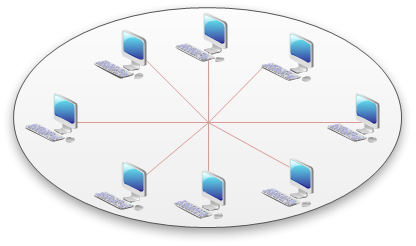

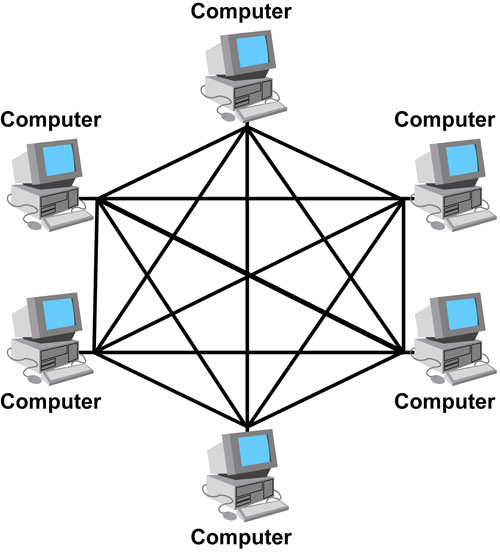
Note that the physical layout of the nodes in a network may not necessarily reflect the network topology. As an example, with FDDI, the network topology is a ring (actually two counter-rotating rings), but the physical topology is often a star, because all neighboring connections can be routed via a central physical location.
Overlay network
An overlay network is a virtual computer network that is built on top of another network. Nodes in the overlay network are connected by virtual or logical links. Each link corresponds to a path, perhaps through many physical links, in the underlying network. The topology of the overlay network may (and often does) differ from that of the underlying one. For example, many peer-to-peer networks are overlay networks. They are organized as nodes of a virtual system of links that run on top of the Internet.
Overlay networks have been around since the invention of networking when computer systems were connected over telephone lines using modems, before any data network existed.
The most striking example of an overlay network is the Internet itself. The Internet itself was initially built as an overlay on the telephone network. Even today, at the network layer, each node can reach any other by a direct connection to the desired IP address, thereby creating a fully connected network. The underlying network, however, is composed of a mesh-like interconnect of sub-networks of varying topologies (and technologies). Address resolution and routing are the means that allow mapping of a fully connected IP overlay network to its underlying network.
Another example of an overlay network is a distributed hash table, which maps keys to nodes in the network. In this case, the underlying network is an IP network, and the overlay network is a table (actually a map) indexed by keys.
Overlay networks have also been proposed as a way to improve Internet routing, such as through quality of service guarantees to achieve higher-quality streaming media. Previous proposals such as IntServ, DiffServ, and IP Multicast have not seen wide acceptance largely because they require modification of all routers in the network. On the other hand, an overlay network can be incrementally deployed on end-hosts running the overlay protocol software, without cooperation from Internet service providers. The overlay network has no control over how packets are routed in the underlying network between two overlay nodes, but it can control, for example, the sequence of overlay nodes that a message traverses before it reaches its destination.
For example, Akamai Technologies manages an overlay network that provides reliable, efficient content delivery (a kind of multicast). Academic research includes end system multicast, resilient routing and quality of service studies, among others.
Communications protocols
A communications protocol is a set of rules for exchanging information over network links. In a protocol stack, each protocol leverages the services of the protocol below it. An important example of a protocol stack is HTTP (the World Wide Web protocol) running over TCP over IP (the Internet protocols) over IEEE 802.11 (the Wi-Fi protocol). This stack is used between the wireless router and the home user's personal computer when the user is surfing the web.
Whilst the use of protocol layering is today ubiquitous across the field of computer networking, it has been historically criticized by many researchers for two principal reasons. Firstly, abstracting the protocol stack in this way may cause a higher layer to duplicate functionality of a lower layer, a prime example being error recovery on both a per-link basis and an end-to-end basis.Secondly, it is common that a protocol implementation at one layer may require data, state or addressing information that is only present at another layer, thus defeating the point of separating the layers in the first place. For example, TCP uses the ECN field in the IPv4 header as an indication of congestion; IP is a network layer protocol whereas TCP is a transport layer protocol.
Communication protocols have various characteristics. They may be connection-oriented or connectionless, they may use circuit mode or packet switching, and they may use hierarchical addressing or flat addressing.
Geographic scale
A network can be characterized by its physical capacity or its organizational purpose. Use of the network, including user authorization and access rights, differ accordingly.
- Personal area network
A personal area network (PAN) is a computer network used for communication among computer and different information technological devices close to one person. Some examples of devices that are used in a PAN are personal computers, printers, fax machines, telephones, PDAs, scanners, and even video game consoles. A PAN may include wired and wireless devices. The reach of a PAN typically extends to 10 meters. A wired PAN is usually constructed with USB and FireWire connections while technologies such as Bluetooth and infrared communication typically form a wireless PAN.
- Local area network
A local area network (LAN) is a network that connects computers and devices in a limited geographical area such as a home, school, office building, or closely positioned group of buildings. Each computer or device on the network is a node. Wired LANs are most likely based on Ethernet technology. Newer standards such as ITU-T G.hn also provide a way to create a wired LAN using existing wiring, such as coaxial cables, telephone lines, and power lines.
All interconnected devices use the network layer (layer 3) to handle multiple subnets (represented by different colors). Those inside the library have 10/100 Mbit/s Ethernet connections to the user device and a Gigabit Ethernet connection to the central router. They could be called Layer 3 switches, because they only have Ethernet interfaces and support the Internet Protocol. It might be more correct to call them access routers, where the router at the top is a distribution router that connects to the Internet and to the academic networks' customer access routers.
The defining characteristics of a LAN, in contrast to a wide area network (WAN), include higher data transfer rates, limited geographic range, and lack of reliance on leased linesto provide connectivity. Current Ethernet or other IEEE 802.3 LAN technologies operate at data transfer rates up to 10 Gbit/s. The IEEE investigates the standardization of 40 and 100 Gbit/s rates. A LAN can be connected to a WAN using a router.
- Metropolitan area network
A Metropolitan area network (MAN) is a large computer network that usually spans a city or a large campus.
- Wide area network
A wide area network (WAN) is a computer network that covers a large geographic area such as a city, country, or spans even intercontinental distances. A WAN uses a communications channel that combines many types of media such as telephone lines, cables, and air waves. A WAN often makes use of transmission facilities provided by common carriers, such as telephone companies. WAN technologies generally function at the lower three layers of the OSI reference model: the physical layer, the data link layer, and the network layer.

No comments:
Post a Comment