The Open Systems Interconnection model (OSI Model) is a conceptual model that characterizes and standardizes the internal functions of a communication system by partitioning it into abstraction layers. The model is a product of the Open Systems Interconnection project at the International Organization for Standardization (ISO), maintained by the identification ISO/IEC 7498-1.
The model groups
communication functions into seven logical layers. A layer serves the layer
above it and is served by the layer below it. For example, a layer that
provides error-free communications across a network provides the path needed by
applications above it, while it calls the next lower layer to send and receive
packets that make up the contents of that path. Two instances at one layer are
connected by a horizontal connection on that layer.
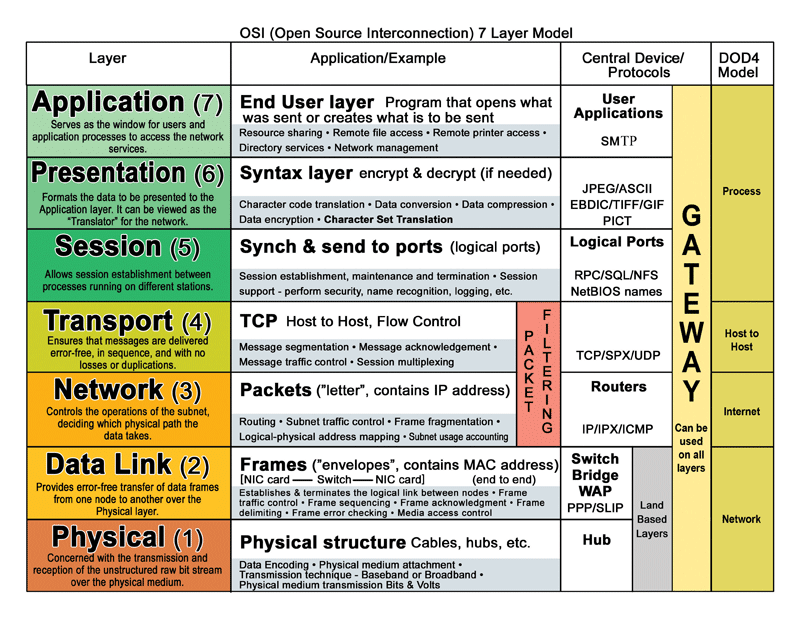
Description
of OSI layers
The recommendation X.200
describes seven layers, labeled 1 to 7. Layer 1 is the lowest layer in this
model.
At each level N two
entities at the communicating devices (layer N peers)
exchange protocol
data units (PDUs) by means of a layer N protocol.
Each PDU contains a payload, called the service data unit(SDU),
along with protocol-related headers and/or footers.
Data processing by two
communicating OSI-compatible devices is done as such:
1. The
data to be transmitted is composed at the topmost layer of the transmitting
device (layer N)
into a protocol
data unit (PDU).
2. The PDU is
passed to layer N-1,
where it is known as the service data unit (SDU).
3. At
layer N-1 the SDU is concatenated with
a header, a footer, or both, producing a layer N-1 PDU.
It is then passed to layer N-2.
4. The
process continues until reaching the lowermost level, from which the data is
transmitted to the receiving device.
5. At
the receiving device the data is passed from the lowest to the highest layer as
a series of SDUs
while being successively stripped from each layer's header and/or footer, until
reaching the topmost layer, where the last of the data is consumed.

Some orthogonal aspects,
such as management and security, involve all of the layers. These
services are aimed at improving the CIA
triad - confidentiality, integrity, and availability -
of the transmitted data. In practice, the availability of a communication service
is determined by the interaction between network design and network
management protocols. Appropriate choices for both of
these are needed to protect against denial of service.
Layer
1: physical layer
The physical layer has
the following major functions:
- It defines
the electrical and
physical specifications of the data connection. It defines the relationship
between a device and a physical transmission medium (e.g., a copper or fiber optical cable). This includes the layout
of pins, voltages,
line impedance, cable specifications,
signal timing, hubs, repeaters, network adapters, host bus adapters (HBA used
in storage area networks) and more.
- It defines
the protocol to establish and terminate a connection between two directly
connected nodes over a communications medium.
- It may
define the protocol for flow control.
- It defines
transmission mode i.e. simplex, half duplex, full duplex.
- It defines topology.
Layer
2: data link layer
The data link layer provides node-to-node data transfer -- a reliable link between two directly connected nodes, by
detecting and possibly correcting errors that may occur in the physical layer.
The data link layer is divided into two sublayers:
- Media Access Control (MAC) layer - responsible for
controlling how devices in a network gain access to data and permission to
transmit it.
- Logical Link Control (LLC) layer - controls error
checking and packet synchronization.
The Point-to-Point Protocol (PPP) is an example of a
data link layer in the TCP/IP protocol
stack.
The ITU-T G.hn standard,
which provides high-speed local area networking over existing wires (power
lines, phone lines and coaxial cables), includes a complete data link layer that
provides both error correction and flow
control by means of a selective-repeat sliding-window protocol.
Layer
3: network layer
The network layer provides
the functional and procedural means of transferring variable length data sequences (called datagrams) from one
node to another connected to the same network. It
translates logical network address into physical machine address. A network is
a medium to which many nodes can be connected, on which every node has an address and
which permits nodes connected to it to transfer messages to other nodes
connected to it by merely providing the content of a message and the address of
the destination node and letting the network find the way to deliver
("route") the message to the destination node. In addition to message routing, the network
may (or may not) implement message delivery by splitting the message into
several fragments, delivering each fragment by a separate route and
reassembling the fragments, report delivery errors, etc.
A number of
layer-management protocols, a function defined in the management
annex,
ISO 7498/4, belong to the network layer. These include routing protocols,
multicast group management, network-layer information and error, and network-layer
address assignment. It is the function of the payload that makes these belong
to the network layer, not the protocol that carries them.
Layer
4: transport layer
The transport layer provides
the functional and procedural means of transferring variable-length data
sequences from a source to a destination host via one or more networks, while
maintaining the quality of service functions.
An example of a
transport-layer protocol in the standard Internet stack is Transmission Control Protocol (TCP), usually built on top
of the Internet Protocol (IP).
The transport layer
controls the reliability of a given link through flow control, segmentation/desegmentation,
and error control. Some protocols are state- and connection-oriented. This
means that the transport layer can keep track of the segments and retransmit
those that fail. The transport layer also provides the acknowledgement of the
successful data transmission and sends the next data if no errors occurred. The
transport layer creates packets out of the message received from the
application layer. Packetizing is a process of dividing the long message into
smaller messages.
OSI defines five classes of
connection-mode transport protocols ranging from class 0 (which is also known
as TP0 and provides the fewest features) to class 4 (TP4, designed for less
reliable networks, similar to the Internet). Class 0 contains no error
recovery, and was designed for use on network layers that provide error-free
connections. Class 4 is closest to TCP, although TCP contains functions, such
as the graceful close, which OSI assigns to the session layer. Also, all OSI TP
connection-mode protocol classes provide expedited data and
preservation of record boundaries. Detailed characteristics of TP0-4 classes
are shown in the following table:
Feature
name
|
TP0
|
TP1
|
TP2
|
TP3
|
TP4
|
Connection-oriented network
|
Yes
|
Yes
|
Yes
|
Yes
|
Yes
|
Connectionless network
|
No
|
No
|
No
|
No
|
Yes
|
Concatenation and separation
|
No
|
Yes
|
Yes
|
Yes
|
Yes
|
Segmentation and reassembly
|
Yes
|
Yes
|
Yes
|
Yes
|
Yes
|
Error recovery
|
No
|
Yes
|
Yes
|
Yes
|
Yes
|
Reinitiate connectiona
|
No
|
Yes
|
No
|
Yes
|
No
|
Multiplexing / demultiplexing
over single virtual circuit
|
No
|
No
|
Yes
|
Yes
|
Yes
|
Explicit flow control
|
No
|
No
|
Yes
|
Yes
|
Yes
|
Retransmission on timeout
|
No
|
No
|
No
|
No
|
Yes
|
Reliable transport service
|
No
|
Yes
|
No
|
Yes
|
Yes
|
An easy way to visualize
the transport layer is to compare it with a post office, which deals with the
dispatch and classification of mail and parcels sent. Do remember, however,
that a post office manages the outer envelope of mail. Higher layers may have
the equivalent of double envelopes, such as cryptographic presentation services
that can be read by the addressee only. Roughly speaking, tunneling
protocols operate at the transport layer, such as carrying non-IP
protocols such as IBM's SNA or Novell's IPX over an IP network, or end-to-end encryption
with IPsec. While Generic Routing Encapsulation (GRE) might seem to be a
network-layer protocol, if the encapsulation of the payload takes place only at
endpoint, GRE becomes closer to a transport protocol that uses IP headers but
contains complete frames or packets to deliver to an endpoint. L2TP carries PPP frames inside transport packet.
Although not developed
under the OSI Reference Model and not strictly conforming to the OSI definition
of the transport layer, the Transmission Control Protocol (TCP) and the User Datagram Protocol(UDP) of the Internet Protocol
Suite are commonly categorized as layer-4 protocols within OSI.
Layer
5: session layer
The session layer controls
the dialogues (connections) between computers. It establishes, manages and
terminates the connections between the local and remote application. It
provides for full-duplex, half-duplex, or simplex operation, and establishes checkpointing,
adjournment, termination, and restart procedures. The OSI model made this layer
responsible for graceful close of sessions, which is a property of the Transmission Control Protocol, and also for session
checkpointing and recovery, which is not usually used in the Internet Protocol
Suite. The session layer is commonly implemented explicitly in application
environments that use remote procedure calls.
Layer
6: presentation layer
The presentation
layer establishes
context between application-layer entities, in which the application-layer
entities may use different syntax and semantics if the presentation service
provides a big mapping between them. If a mapping is available, presentation
service data units are encapsulated into session protocol data units, and passed
down the protocol stack.
This layer provides
independence from data representation (e.g., encryption) by
translating between application and network formats. The presentation layer transforms
data into the form that the application accepts. This layer formats and
encrypts data to be sent across a network. It is sometimes called the syntax
layer.
The original presentation
structure used the Basic
Encoding Rules of Abstract Syntax Notation One (ASN.1), with capabilities
such as converting an EBCDIC-coded
text file to
an ASCII-coded file, or serialization of objects and other data structures from
and to XML.
Layer
7: application layer
The application layer is
the OSI layer closest to the end user, which means both the OSI application
layer and the user interact directly with the software application. This layer
interacts with software applications that implement a communicating component.
Such application programs fall outside the scope of the OSI model.
Application-layer functions typically include identifying communication
partners, determining resource availability, and synchronizing communication.
When identifying communication partners, the application layer determines the
identity and availability of communication partners for an application with
data to transmit. When determining resource availability, the application layer
must decide whether sufficient network or the requested communication exists.
In synchronizing communication, all communication between applications requires
cooperation that is managed by the application layer. Some examples of
application-layer implementations include:
- On OSI
stack:
- FTAM File
Transfer and Access Management Protocol
- X.400 Mail
- Common Management Information Protocol (CMIP)
- Unified Diagnostic Services (UDS)
- On TCP/IP
stack:
- Hypertext Transfer Protocol (HTTP),
- File Transfer Protocol (FTP),
- Simple Mail Transfer Protocol (SMTP),
- Simple Network Management Protocol (SNMP),
etc.
Cross-layer
functions
There are some functions or
services that are not tied to a given layer, but they can affect more than one
layer. Examples include the following:
- Security service (telecommunication) as defined
by ITU-T X.800
recommendation.
- Management
functions, i.e. functions that permit to configure, instantiate, monitor,
terminate the communications of two or more entities: there is a specific
application-layer protocol, common management information protocol (CMIP) and
its corresponding service, common management information service (CMIS),
they need to interact with every layer in order to deal with their
instances.
- Multiprotocol Label Switching (MPLS)
operates at an OSI-model layer that is generally considered to lie between
traditional definitions of layer 2 (data link layer) and layer 3 (network
layer), and thus is often referred to as a "layer-2.5" protocol.
It was designed to provide a unified data-carrying service for both
circuit-based clients and packet-switching clients which provide a datagram-based
service model. It can be used to carry many different kinds of traffic,
including IP packets, as well as native ATM, SONET, and Ethernet frames.
- ARP is used to translate IPv4 addresses (OSI layer 3) into
Ethernet MAC addresses (OSI layer 2).
Interfaces
Neither the OSI Reference
Model nor OSI protocols specify any programming interfaces, other than as
deliberately abstract service specifications. Protocol specifications precisely
define the interfaces between different computers, but the software interfaces
inside computers, known as network sockets are
implementation-specific.
For example Microsoft Windows' Winsock, and Unix's Berkeley sockets and System V Transport Layer Interface, are interfaces between
applications (layer 5 and above) and the transport (layer 4). NDIS and ODI are interfaces between the media (layer 2)
and the network protocol (layer 3).
Interface standards, except
for the physical layer to media, are approximate implementations of OSI service
specifications.


YOUR BLOG VRY NYC SO plz update regulary.......
ReplyDelete